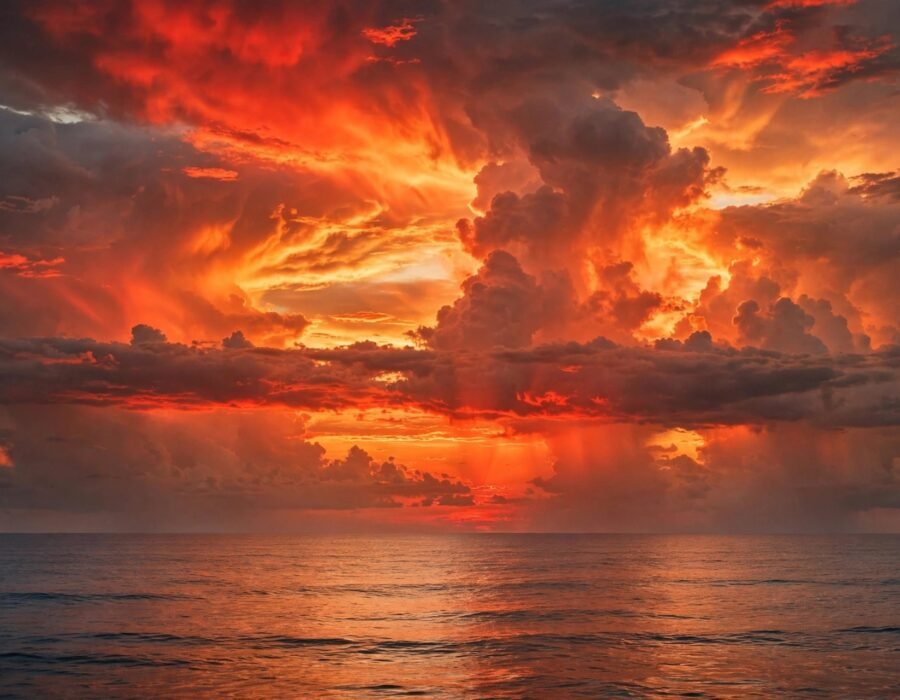
At noon the sky is blue. At sunset it burns red, orange, and pink — the same sun, the same sky, utterly transformed. Children ask why, poets rhapsodize about it, and photographers chase it across continents. If you have ever wondered how to understand why the sky looks red at sunset, the answer is one of physics’ most elegant stories: it is about the size of air molecules, the path of light, and the selective murder of blue photons. Once you see it, you will never watch a sunset the same way again.
The short version: sunlight looks white but contains all colors. As it passes through the atmosphere, tiny air molecules scatter short-wavelength blue light in all directions — which is why the daytime sky is blue. At sunset, sunlight travels through far more atmosphere to reach your eyes, and by the time it arrives, nearly all the blue has been scattered away, leaving the reds and oranges to dominate. The sunset is the daytime sky’s blue, removed.
Rayleigh Scattering: The Main Character
In 1871, Lord Rayleigh worked out the mathematics: particles much smaller than the wavelength of light scatter short wavelengths far more efficiently than long ones. The scattering strength scales with the inverse fourth power of wavelength — blue light (around 450 nanometers) scatters roughly five times more strongly than red (around 650 nanometers). Air molecules — nitrogen and oxygen — are the perfect size to do this to sunlight.
During the day, the sun is overhead and its light takes the short path through the atmosphere. Blue light scatters everywhere — some of it toward your eyes from every direction — so the whole sky glows blue. The sun itself looks slightly yellow-white because a little blue has been removed from the direct beam. Now tilt the geometry: at sunset, sunlight grazes the atmosphere at a shallow angle, traveling up to 40 times farther through air. That marathon path scatters away essentially all the blue and much of the green and yellow. What survives the journey is red and orange — the colors too stubborn to scatter. NOAA’s atmospheric science resources explain this geometry with excellent diagrams.
Why Sunsets Vary: Dust, Clouds, and Pollution
Not all sunsets are equal, and the variations prove the physics. After major volcanic eruptions, sunsets worldwide turn spectacularly vivid for months — the 1991 Mount Pinatubo eruption produced unforgettable twilights across the globe. Volcanic aerosols, larger than air molecules, scatter light differently (Mie scattering), amplifying reds. Desert dust, sea salt, and even wildfire smoke do the same on smaller scales: the apocalyptic orange skies during wildfire season are sunlight filtered through smoke particles.
Clouds are the canvas. High, thin cirrus clouds catch the red light long after the sun dips below the horizon and reflect it downward — the classic “burning sky” effect. Low thick clouds block it. Humidity, air pressure, and the cleanliness of the air all modulate the result, which is why desert sunsets (dry, dusty air) and tropical sunsets (clean maritime air over the ocean) have such different characters. Forecasting a great sunset is genuinely possible: how AI is used in weather forecasting covers the models that predict the cloud and aerosol conditions behind the colors. Mid-latitude sunsets after a cold front — clean air plus scattered high clouds — are reliably the best.
Pollution and Sunsets: The Uncomfortable Truth
There is a persistent myth that pollution makes prettier sunsets. The reality is nuanced: some particulates enhance reds, but heavy pollution typically produces hazy, washed-out sunsets, not vivid ones. The most spectacular sunsets come from clean air with the right clouds, or from natural aerosols like volcanic ash. The EPA’s air quality data lets you check your local particulate levels — and you will notice the finest sunsets often follow the cleanest days after a front passes.
The Blue Hour and Other Atmospheric Tricks
The show does not end at sunset. During twilight’s “blue hour,” the sun is below the horizon but its light still illuminates the upper atmosphere, scattering blue down while the surface darkens — photographers prize this window. The Belt of Venus, a pinkish band above the eastern horizon opposite the sunset, is backscattered red light. The Earth’s shadow itself becomes visible as a dark blue-gray band rising in the east.
And the same physics runs in reverse at sunrise — though sunrises are statistically less vivid, because overnight the air settles and contains fewer of the particles that amplify color. Afternoon activity stirs dust and pollution into the air, giving sunsets the edge. It is a small asymmetry, but photographers have logged it for generations: all else equal, bet on dusk over dawn.
Sunsets on Other Worlds
Every planet with an atmosphere gets its own version. Mars, with its thin carbon-dioxide air full of fine dust, has butterscotch daytime skies and blue sunsets — the reverse of Earth’s, because Martian dust scatters red light and lets blue through near the sun. NASA’s rovers have photographed them: a pale blue glow around the setting sun on an alien world. Titan, Saturn’s moon, wears a thick orange haze that would make every sunset a permanent amber gloom. The physics is universal — Rayleigh and Mie scattering work everywhere — but each atmosphere paints with its own palette.
The Bottom Line
The sky looks red at sunset because sunlight’s long, shallow path through the atmosphere scatters away the blue light, leaving reds and oranges to reach your eyes — Rayleigh scattering applied at planetary scale. Dust, clouds, and air quality conduct the variations, which is why no two sunsets match. It is physics you can verify with your own eyes every clear evening, no equipment required. And if the colors ever look strange — greenish tints before a tornado, milky white in wildfire smoke — the sky is telling you something about the air itself. Look up; it is always talking. Just remember that chasing the perfect sunset across time zones comes with a cost — how to avoid jet lag on long flights will help if your sunset-chasing goes intercontinental.
Frequently Asked Questions
Why is the sky blue during the day but red at sunset?
The same process — Rayleigh scattering — produces both. At noon, sunlight’s short atmospheric path scatters blue light in all directions, making the sky blue. At sunset, the much longer path scatters away nearly all blue, leaving only red and orange wavelengths to reach your eyes.
Do clouds make sunsets better?
High, thin clouds do — they catch red sunlight after the sun sets and reflect it down. Low, thick clouds block the light and ruin the show. The best sunsets need partial high cloud cover, which is why completely clear or fully overcast evenings disappoint.
Why are desert sunsets so colorful?
Dry desert air contains fine dust particles that enhance scattering of red wavelengths (Mie scattering), and the typically clear skies provide an unobstructed canvas. The combination of dust plus clean air plus cloudless horizons produces famously saturated colors.
Can pollution really improve sunsets?
Mostly a myth. Light particulate haze can add some color, but heavy pollution creates washed-out, brownish sunsets. The most vivid sunsets come from clean air after cold fronts, or natural aerosols like volcanic ash — not smog.